

Friends,
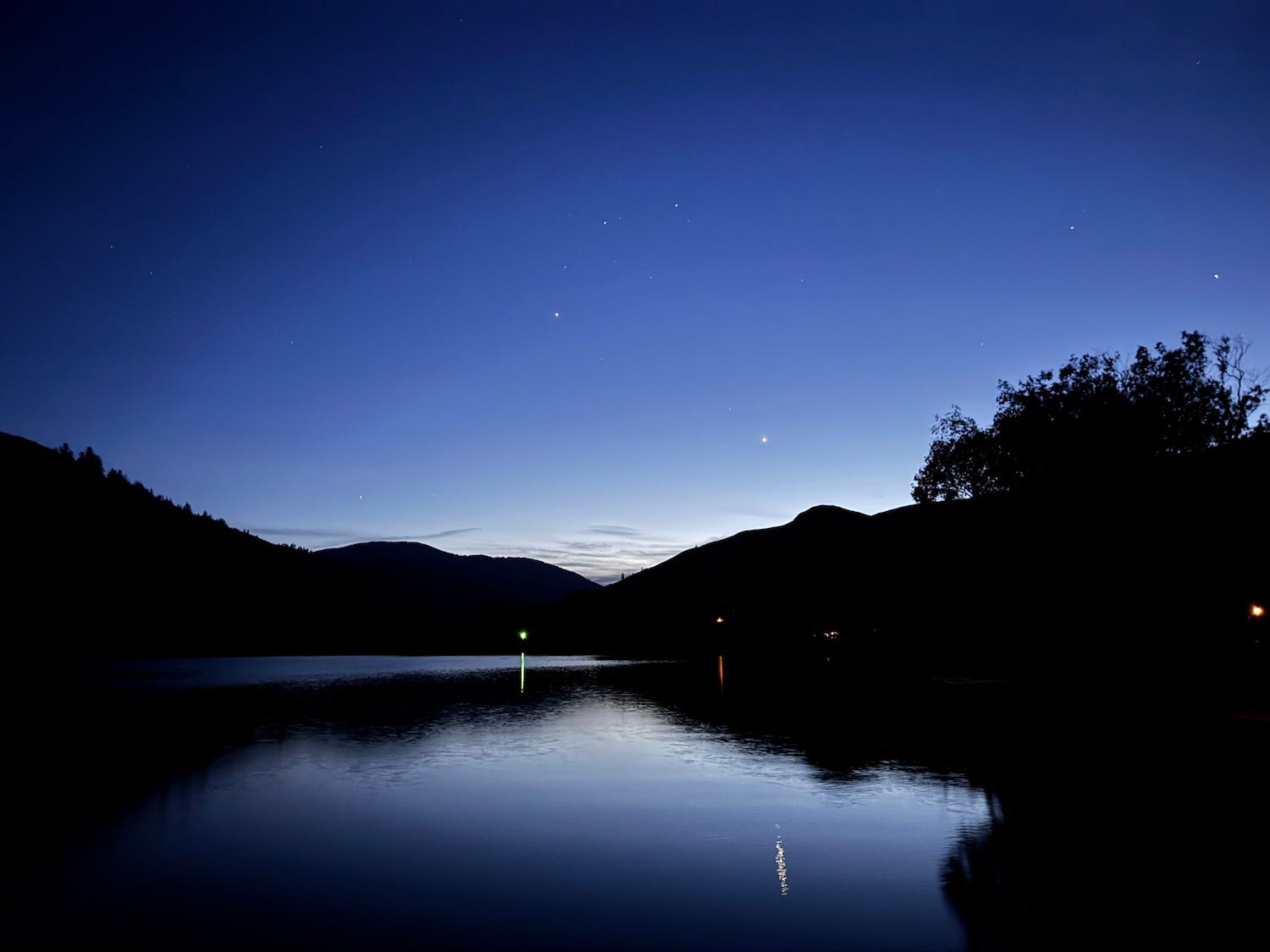
Spectacle Lake sits east of the Cascade Mountains in the Okanogan’s Whitestone Coulee, where the rain shadow strips away humidity that blocks the stars. This is shrub-steppe country, with dry coulee hillsides, sage and bunchgrass, where the long brown folds of North Central Washington roll down to the water. With little ambient light, skies can get dark here: often a Bortle 2 to 3 rating, depending upon how the night cooperates—and where you plant your tripod.
Bortle may be a new term to you. It’s how stargazers rank darkness, with Class 1 representing the darkest sky on Earth. Conversely, Class 9 reads as a city center, where a person can see little more than the moon and a couple of bright planets. Seattle? A 7 or an 8. Anything at 4 or lower is Milky Way country.
So, when our camping group included a few nights at Spectacle Lake on our two-week route, four of us, all women and all long-time friends, decided we’d try something new. While there, we’d shoot the Milky Way.
Our gear ranged from iPhones and Androids to a fancy DSLR. All the cameras were low-light capable. We had shot the moon before, but when it came to taking serious star pics? Well, apart from some pre-trip Googling, none of us had any experience.
We four compared notes. Anticipated. And while sunset stole the breeze and rolled the lake flat and silvery, we established our camera settings, set shutter timers, and chose tripod locations on the dock.
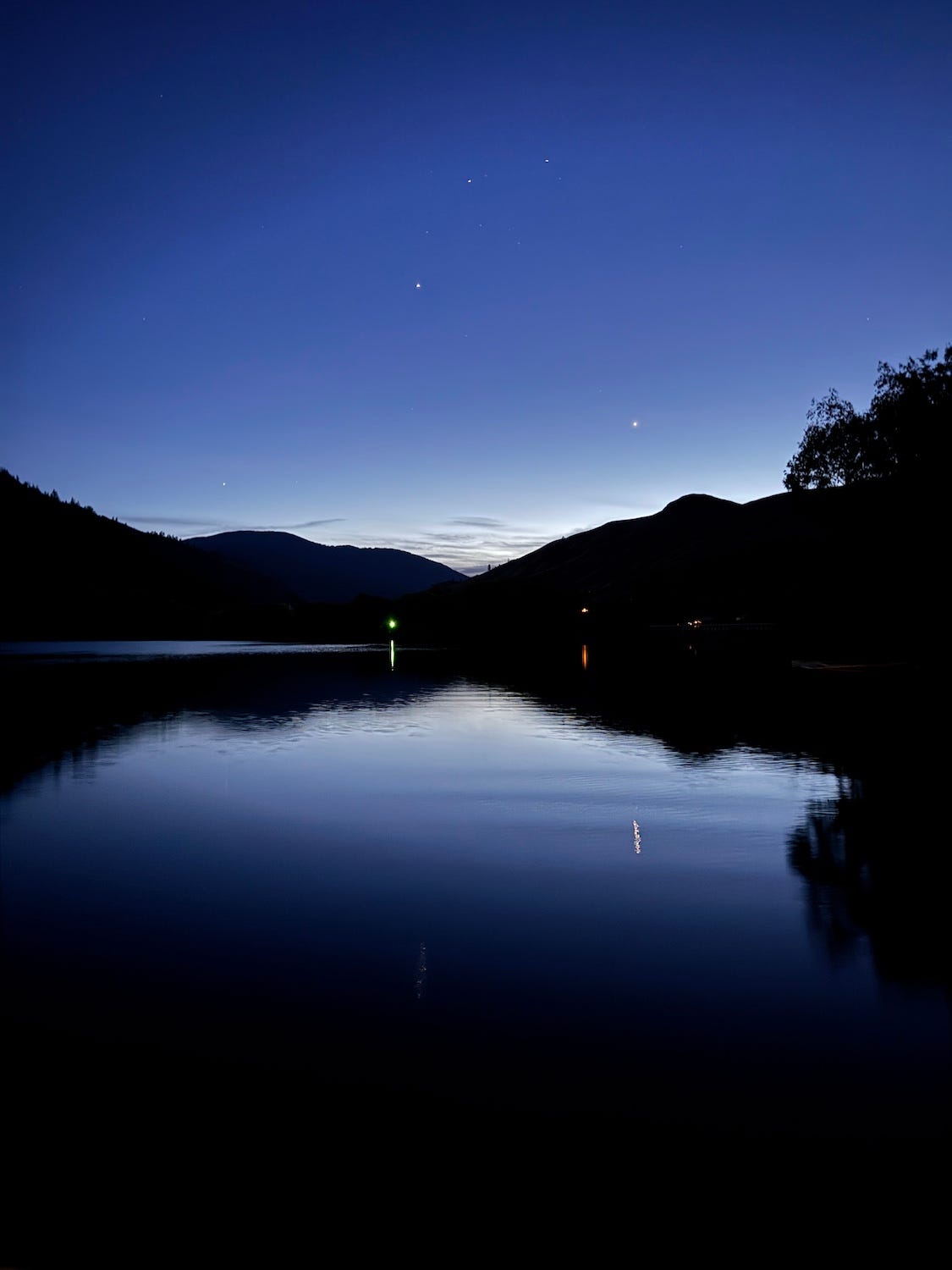
The sky held promise. So much so, that by the time Venus popped awake in the twilight, I was jazzed—eager to snap shots to the playlist I’d built earlier. Pachelbel’s Canon. Vivaldi’s Concerto in A Minor. Background music, to echo the sky’s orderly grandeur and perfection while we captured it through our lenses.
But, since the waxing gibbous moon wouldn’t set, nor the galactic core climb above the hills to the southeast until around 2:00 in the morning, we had to wait. And, since we’re not high-energy kids at slumber parties anymore, we crawled into sleeping bags around 10:00 pm, determined to snag a few hours of sleep.
Right. I managed two.
After that, thoughts of transcendence banished any shut-eye for me. Sure, I’d seen others’ Milky Way photos, but this night, I wanted for my friends and myself the first-hand awe over those billions of sparkling stars. Not just a snapshot of God’s handiwork. I hoped for the thing itself, overhead, in the deep of the night. Hoping to visually taste the milk of the galaxy, I lay awake, watching the sky.
Not to be. Somewhere between 1:00 and 2:00, haze rolled in, eclipsed the stars, and magnified light from the smattering of docks around the lake. The combo? Ruinous.
We roused anyway. I set the music on low as we stumbled to the dock and positioned our gear. But that haze so thoroughly screened the sky behind it that I could not locate a single star in the southeast as a focal point. Not one. Unable to see a blasted thing, I tripped over my tripod, trying, then blinded my friends with my iPhone flashlight. None of us got a single shot worth beans.
“I love this night,” friend Carol said to herself, to nobody, to everybody.
The next morning I scanned my miserable pics. “LightRoom will help,” I told myself. Surely something was hidden there.
Nope. I tried a dozen ways and backwards to extract those stars, but editing tools that usually work for me failed. Finally, as a last resort, I submitted one dismal photo to AI and asked it to parse out the shot. To find the Milky Way in the mess.
Imagine my reaction when this shot came through.
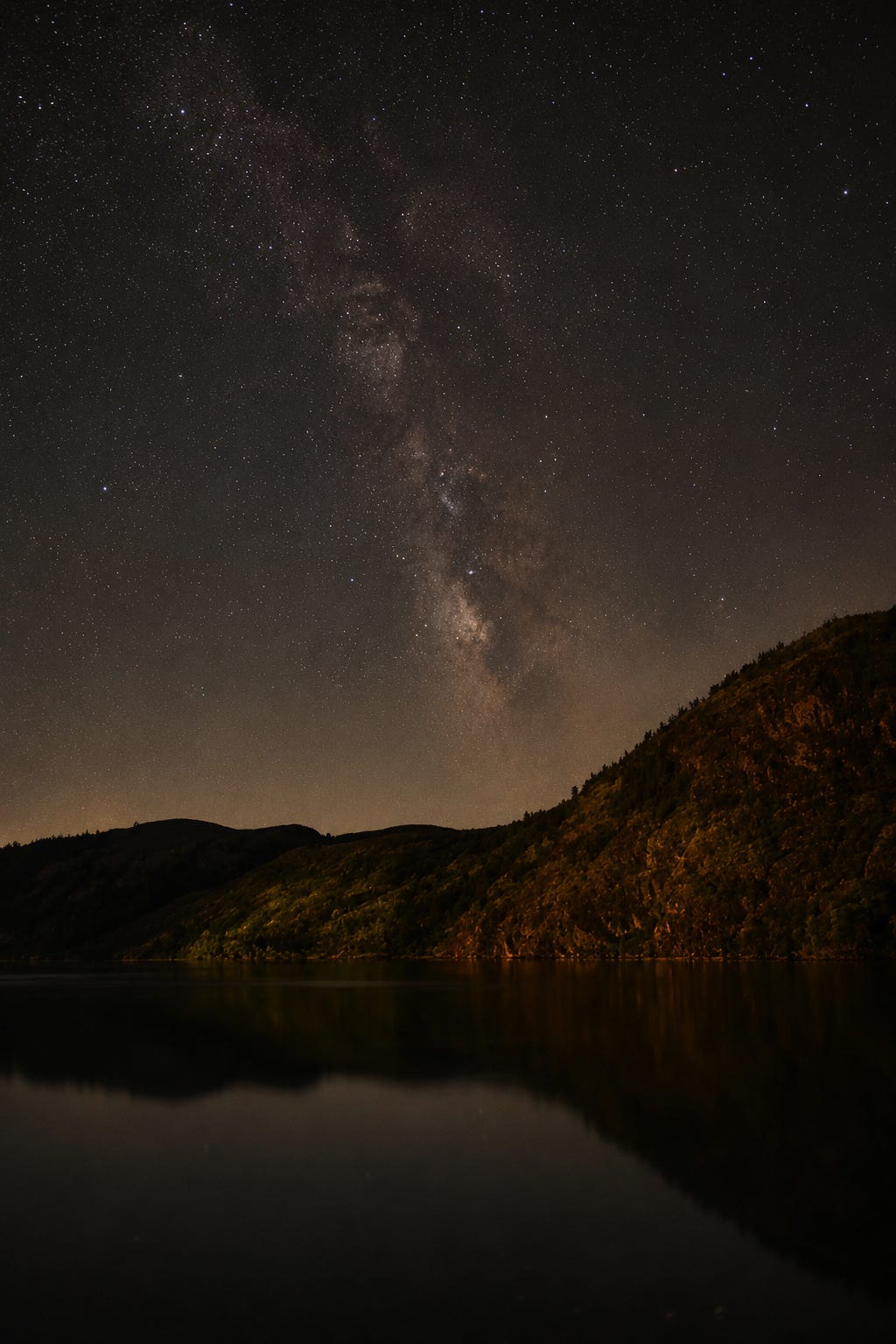
The glee lasted all of fifteen seconds before suspicion replaced my delight. I eyed the image, opened the chat box, and typed. “Did you find the Milky Way or add it?”
You know AI’s answer. No matter how that creature spins it, the photo’s a fake.
Except I couldn’t stop looking at it.
Because here’s what’s real about that image: it was the precise picture I had driven to Okanogan County to capture. An exact illustration of my hope. While useless as evidence, it was perfectly accurate as my aim.
I had imagined that image for weeks. It’s why I researched Bortle ratings. It’s why I checked moon phases. It’s why I stood on a dock at two in the morning adjusting the ISO on a camera pointed at a wall of black.
Most importantly, the image brought to mind two crucial questions I often ask myself—and a reminder that how I answer them will affect not only how I remember that image and that night, but the quality of my days going forward.
***Your monthly free post will arrive the first Saturday of the month, as usual.